Showing posts with label science. Show all posts

Friday, January 11, 2013

Tell Me Some Parts of the Earth Cycle 1 Week 13

Classical Conversations Science, Cycle 1 Week 13

Tell me about some parts of the earth.

 That sounds like an open invitation for some playdoh! We created ours out of 4 colors of playdoh, one each for the inner core, outer core, mantle, and crust.  I didn't make these quite to scale because all of my tubs of playdoh were the same size, but when I did it for my abecedarian class, I made homemade dough (and added some glitter to it! yay!) and was able to scale it better so that the mantle was larger than the other sections.  I think doing the inner core in a solid ball of something (maybe a bouncey ball from a vending machine?) would be really great, too! How cool is it that the center of the earth is so incredibly hot, but yet it's solid because of the incredible pressure?  So cool!
 For my abecedarians, I also wanted to reinforce the hydrosphere, biosphere, and atmosphere, so we printed out a coloring page of the beach:
And I let the kids color their picture and then glue on labels.  The beach theme was nice because it had life (bio), water (hydro) and air (atmo).  They had so much fun doing some projects during class, which I really enjoy doing with them when I get time.  Typically our classes are so quick and tight there's not time for anything fun, and I know Leah Bortin's vision is "stick in the sand" but teaching is more fun for me when I get to be creative, so our "first day" of each 12 weeks is my favorite because we can have fun :)


Wednesday, September 12, 2012

Cycle 1 Week 4 Science- Plant Cell

Tell you some parts of a plant cell?

I could....but I'd rather nom on some parts of a plant cell :) Hot on the heels of our Animal Cell Brownie  we bring you plant cell veggie bread.

Veggie bread is the brainchild of a friend of mine, who even brought me some at 11pm one night when I was putting together CC materials for our community.  Love her!  We went to her house so our kids could work together making their cells.

You'll need 1 8-ounce cream cheese, softened, 1/2 a packet of Hidden Valley Ranch dressing mix, and a can of refrigerator crescent rolls, which they even sell without perforations in a flat sheet.

Step one: Unroll the crescent dough and lay it flat on a cookie sheet.  Bake until golden and delicious according to the package directions.

Step two: using a hand mixer (or muscles, whatever), combine the ranch dressing mix and cream cheese until well-combined and spreadable.

Also, you'll need veggies.  We used cucumber for chloroplasts, carrot peelings for golgi bodies, broccoli for mitochondria, the ranch cream cheese for cytoplasm, the crescent bread for cell membrane, the baking sheet for cell wall, a pile of chopped cauliflower for vacuoles and a tomato slice for the nucleus.
We had 4 children and let them each take turns putting the organelles and telling us what each one does.  This was great review for last week, too!
We recommend making 2 of these....one like this for the kiddos and one with finer chopped veggies for the grown ups to enjoy :) Happy cell making!

Tuesday, September 11, 2012

CC Week 3 Science- Tasty Tasty Cells

I think that it's a generally accepted fact that if you can craft something out of food, your children will remember it.

Or, maybe that generally accepted fact is that calories don't count if they are educational.

Something like that.  One of those must be true.

Science week 3 is tell me some parts of an animal cell.  Armed with my debit card, and the need to fill up my tank of gas, and the desire to burn an afternoon, I picked up several kinds of candy, and when we got home, I had my oldest make brownies as a reading comprehension exercise.  (That means he reads and follows the directions and I sit and try to keep my mouth shut unless he's read a fraction incorrectly and is about to put "1 or 2 cups of oil" instead of 1/2 cup of oil).

 A cake would work equally as well.  You'll need a cell base (cake or brownies, we used a round pan), frosting (because cytoplasm tastes better as sugar), and then various things to use as organelles.
 Optional, but I labeled a paper plate and put stars on the ones we actually had in the memory work.  I may have over-bought treats.  We used a cookie for the nucleus, honey cashews for the mitochondria, peanut butter M&Ms for the vacuoles, gummy worms for golgi bodies, and skittles for the lysomes and centrisomes.  I used cake sprinkles for ribosomes.
 Spreading is an important pre-writing skill. (I can't prove that)
The finished cell.  It was delicious! Everyone asked for a piece based on the type of organelles they wanted to get, and they told daddy about the various parts and functions before we dug in.

Wednesday, September 5, 2012

The 5 Kingdoms/Classification

Classical Conversations Cycle 1 Science Week 1 and Week 2 cover the classification of living things and the five kingdoms.  

Riley has an assignment to do a poster on Orangutans this week (which is great because it lines up with a cub scout achievement!), but in addition to that, here's what we did:

 These were our in-class projects.  We divided a paper into 5 sections, copied the words down from the board to label each of the 5 Kingdoms, and then pasted pictures from the computer and magazines to show examples.  Monerans are readily available in medicine ads- especially Neosporin :)
 Then we enjoyed our first field trip of the year with our CC group! We planned a trip to the National Zoo.  My plan had been to bring a 5 Kingdoms scavenger hunt, but I left the papers at home.  Sigh.
 When you look at the various writings on each animal, you can point out the binomial nomenclature, which gives a latin name with the genus and the species.  Similar families are grouped together, and houses are usually done by class or order, depending on the size of the zoo! God made all creatures, and using the similarities, we can group and order them.  We see evidence of God's order in the universe, even at the zoo!
I love this guy! He was cheesing for the camera and looked almost happy to see us! (I'm sure if I'd stuck my hand in his terrarium, he'd have been happy to eat it, though!) 
Here's our little crew after making it all the way to the Flamingos (our friend KM has to do her report this week on Flamingos).  It was warm, and we had a little mini-emergency when a fellow CC mom had 2 of her kids go rogue and enjoy the reptile house alone ;) but we found them, and all was well.  This was a great field trip to fill in some real-life with our memory work pegs! It's always amazing to me how diverse life is! I especially love the poison arrow frogs, they look too tiny and intricate to be real, but they are!

Sunday, August 26, 2012

Classical Conversations Cycle 1 Week 1 Science and Art

I didn't include my printables for Science and Art for Cycle 1 Week 1, so I'm doing them in a separate post, and I hope that's not too confusing!

Science: Baby Bean Experiment from Van Cleave Science .
I tutor an Abecedarian class (it's a fun class, but with ages 3, 4, 5, and 6), so I want to leave myself some grace to skip an overly-long explanation, but still provide children with all the information and ideas.  I also don't want anything too "writing intensive", so in addition to demonstrating the experiment, I provided the children with a dry and wet bean to break apart and explore, as well as a few beans to plant and draw into their science journals at home.  I sent home an explanation of what we were doing, along with pictures so the kids could follow along with the steps and concepts.  Yay for iPhone pictures as a learning tool ;) I included a diagram of the bean parts in the back with numbered parts that I encouraged the kids to color when they got home (one color for each part) since we ran out of time.
So then there was art.  I have to admit that I'm super nervous about teaching art.  I'm not really an artist and I'm not terribly comfortable pushing kids outside of their comfort zone where art is concerned, since I'm not in mine either!!  This week's Cycle 1 Week 1 Art was OiLS, or "Basic Shapes".  O for circles, i for dots and line, L for angle lines, and S for curved lines.  I decided to fold a sheet of paper in half and then in thirds and let the kids fill in examples of each of the basic shapes.  We didn't do a great job on creating an image using the basic shapes, and that was my fault.  I offered several suggestions and with such a mixed age group, I think we'd have done better if I mandated that we were drawing a bird and then demonstrated each shape as we added it.  We were at the beach the week before CC started, so I just hand-drew my charts, but you could just as easily print them. 


Saturday, February 18, 2012

CC Science Club: Chinese New Year

Yes, yes, this happened in January.  So sue me.  We use a book I picked up at the library, but you can also get it on Amazon.  For the January lesson, we talked about phase changes.  

First, we read a few books about the Chinese New Year.  Then we made a Venn Diagram about the differences and similarities between the Chinese and the American New Years.  The kids did really well! 


Next I did a demo by making poppers that were completely unsuccessful at the library (using off-brand alka-seltzer and water in an old-school film canister, which was really hard to find!) but worked at home.  It was supposed to tie in with the "Fireworks/explosions" portion of the Venn Diagram.  Next we separated into groups and showed how a liquid (vinegar) and a solid (baking soda) can produce a reaction in the form of a gas (carbon dioxide), which we could see by inflating a balloon over a soda bottle. 

Helpful hint: Use a paper cone to pour the baking soda into the balloon.  Measure the vinegar into the soda bottle, and then attach the balloon to the top of the bottle.  When you stand the balloon up, the baking soda goes in, but you've got all the time in the world to attach your balloon, unlike if you try to mix the elements and THEN put the balloon on top. 


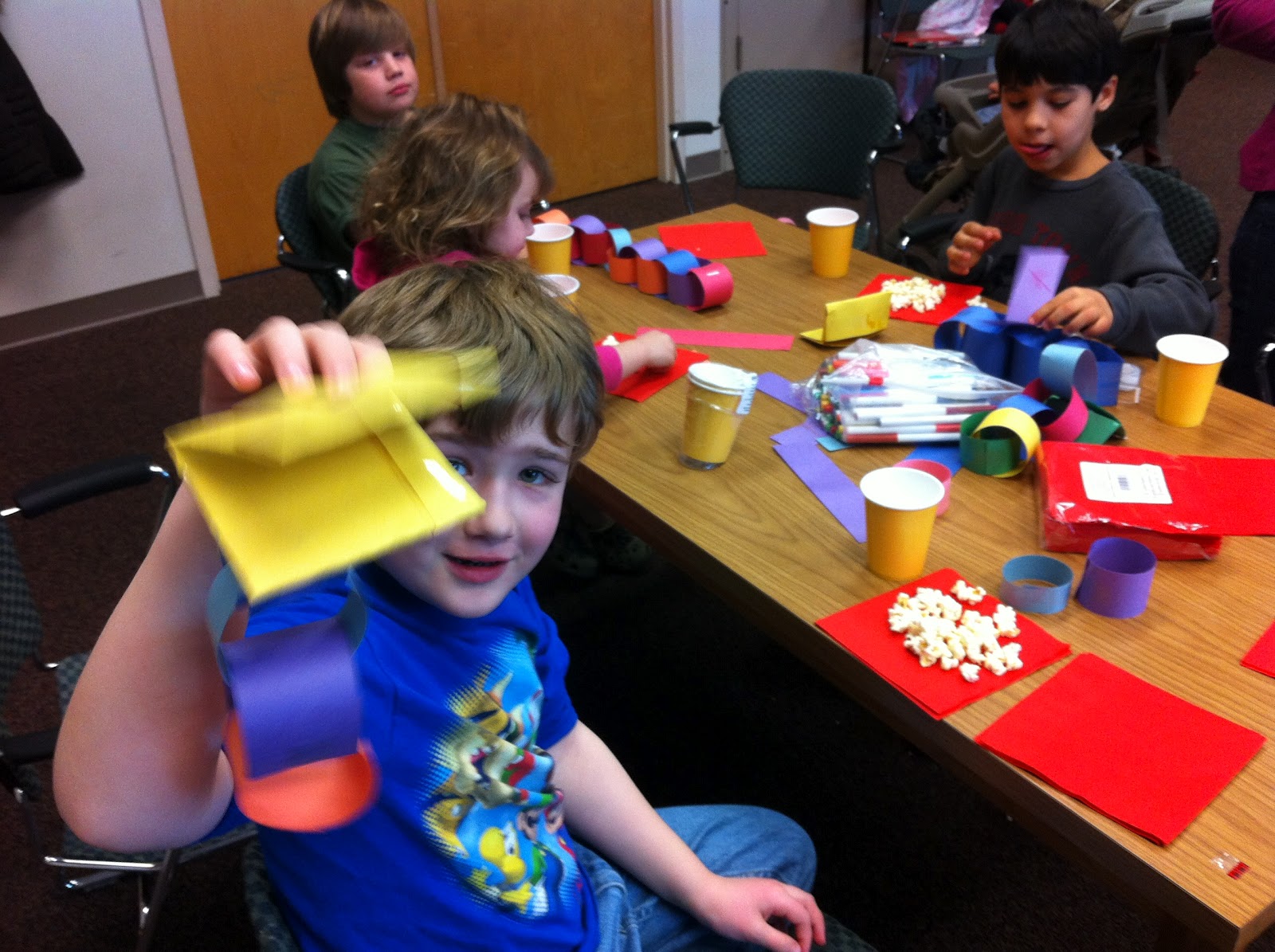
Then it was time for snack and crafts!! The book (and my original plan) suggests doing mini egg rolls, but since there were supposed to be too many kids to have it at my house (fully 1/2 of the people who RSVP'd didn't come), we were at the library and I wasn't sure what our kitchen options were going to be, so we did popcorn (get it, it's popping/exploding?)


Then the kids worked on a really simple craft that I based on a Pinterest find. This was also a second choice, the first choice craft involved paint, which I decided was a bad idea at the library, but the kids seemed to enjoy making puppets, and they're younger, so this was good.


 We had a great time! The science club idea seems to work well for us and for our CC friends! I didn't take any pictures from our February club, which we had this week on Monday, but we did polymers using Teflon Tape and plastic bags.  We had fun learning we could stretch vertically and distort the images and then pull horizontally and realign the molecules! Our crafts were just fun heart-shaped foam activities from Michaels.  I had a bunch of events that all happened on the same day, so a CC friend greatly blessed me by saying she'd bring a craft.  I really didn't feel like I fit in our community at the beginning of the year (I still don't) but I've been very supported by


Thursday, August 11, 2011

In Which We Live and Let Live

One of the things I love about the concept of what we're going to be doing is that it gives us a great deal of time to explore when we're done with our core work.  And there's oh so much to explore. 

Meet Charlotte:
(Photo courtesy of Logan).  She's an ENORMOUS (probably a good 3.5-4 inches from leg tip to leg tip) black and yellow spider who has taken up residence on a hosta bush at grandma's house near the pool.  Also called writing spiders because of the distinctive zig-zag central line they draw in their webs, these scary things are harmless to humans (other than scaring the bejeebus out of you if you find one on yourself!) which was good news for this spider since the kids were certain it must be poisonous and wanted to kill it ASAP.  Now that she's non-venomous to us, they're fascinated with her.

These super neat spiders are different than almost anything in nature we've read about because the females are both larger and more colorful.  Males are small and brown.  Riley argued with me that I had it backwards and gave me specific examples of every bird we've spotted this summer.  Cardinals, blue jays, orioles, the boys are bright and the girls are ugly.  I liked that he remembered :)

The spider also eats the center of its web every night to recycle the chemicals used in web-making and then respins the center and the zigzag (called a stabilimentum).  The kids spent the night at grandma's last night and armed with the knowledge their would be a new web this morning, Logan was outside at the crack of dawn to take a good picture.

:)